Attribution
Ecommerce acquisition attribution
Attribution assigns credit for an order to marketing interactions under a chosen rule.
Attribution assigns credit for an order to marketing interactions under a chosen rule. It describes observed journeys and credited orders under that rule, not additional orders that advertising caused. An ecommerce team should understand the rule, the missing data and the quality of the acquired customers before moving budget.
Check what the report includes
A report’s coverage is part of its meaning. Shopify’s marketing reports summarise information from all Online Store channel orders, while reports on campaigns created with marketing apps are a separate report type.
Shopify defines a conversion as an online store visitor becoming a paying customer. Check whether the report answers a question about visits, conversions or order value before using it to assess acquisition.
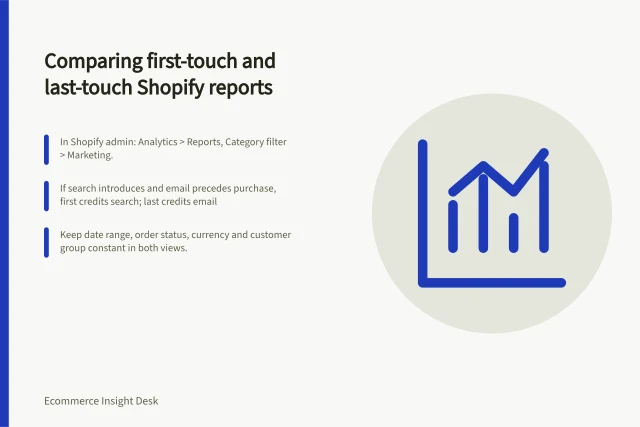
A referrer can be a search, an advertisement, an email or another website link. Shopify’s first-interaction category identifies the referrer that introduced a customer to the store; last interaction identifies the referrer used just before an order. These are descriptions of recorded interactions.
Choose the question before the model
First- and last-interaction reporting answer different questions, so do not compare numbers from two tools as though they share a denominator and window.
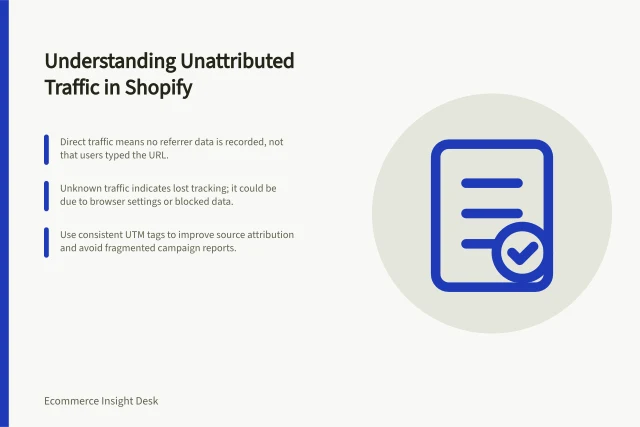
Use a small set of orders to trace the reported source back to actual tagged visits where permitted. Check campaign parameters, referral exclusions, consent effects, cross-device gaps and order status. A “direct” label may mean a typed URL or that no usable referrer was available; it does not prove the customer had no earlier marketing contact. Keep unattributed orders visible instead of redistributing them by assumption.
Match the model to the question
First- and last-interaction views are useful when the decision concerns, respectively, customer introduction or the interaction nearest purchase. They do not distribute credit across the whole journey.
A data-driven model is a different option: Google Ads describes it as using website, store-visit and Google Analytics conversions from Search, including Shopping, YouTube, Display and Demand Gen ads. The model and the conversion sources it uses therefore matter when interpreting a channel comparison.
Choose a model according to the decision the team needs to make and the journey data it can use. If the question concerns how channels work together, a single interaction view may not answer it; multi-touch attribution, media mix modelling or a hybrid approach are alternatives described for marketing measurement. A hybrid should be validated with incrementality testing rather than treated as inherently more accurate.
First-Interaction vs Last-Interaction Attribution: Key Differences
- Focus
- Customer introduction to the store
- Use Case
- Measuring initial awareness or reach of a campaign
- Credit Assignment
- Assigns credit to the first marketing interaction
- Limitation
- Ignores subsequent interactions in the journey
- Focus
- Final interaction before purchase
- Use Case
- Evaluating the effectiveness of retargeting or last-mile campaigns
- Credit Assignment
- Assigns credit to the most recent interaction
- Limitation
- May overvalue last-click efforts and undervalue earlier touchpoints
Treat data availability as a model constraint
Attribution detail can be limited by privacy-related reporting rules as well as by missing journey records. GA4 may withhold data for a report segment when its user count is too low to protect privacy. Smaller campaigns or narrowly defined groups can consequently be less visible; broader segments or longer reporting periods may show more complete trends, though with less detail.
Consent choices can also affect observed journeys. When a user declines analytics cookies, GA4’s direct, granular data collection is reduced; earlier interactions may be missed or only partially inferred if consent is granted later. Consider these gaps when comparing channels, particularly where the decision depends on a complete sequence of visits rather than on an aggregate trend.
Attribution Data Constraints in Australia
- Privacy Thresholds (GA4)
- Data withheld if user count is too low for privacy protection
- Consent Impact
- Declined analytics cookies reduce data granularity
- Referral Exclusions
- Can affect attribution accuracy if not properly configured
Reconcile revenue once
Start from a trusted order total for a defined period and status, then compare each channel report with it. Attribution reports can use different ways of assigning credit, so check the model and reporting basis before interpreting channel totals.
Ad platforms may also each claim the same sale under their own windows. Do not add those credited totals together as store revenue. Label them as attributed claims and explain the model used.
Steps to Reconcile Revenue Across Attribution Reports
- Step 1Start with a trusted, verified order total from Shopify or your POS system
- Step 2Check each channel’s attribution model (e.g., first-touch, last-touch, data-driven)
- Step 3Compare channel-reported totals against the trusted revenue figure
- Step 4Label attributed claims as such — do not sum them as total revenue
Look beyond the first purchase
A channel can bring many low-margin first orders with high refunds, while another brings fewer customers who repeat. Define an acquisition cohort by first purchase date and source, then follow repeat orders, contribution margin, returns and support burden over an agreed period. Compare cohorts with similar maturity and product mix. Recognise that source classification may change with tracking limitations.
Attribution is most useful as a diagnostic: it shows where reported credit moves when a rule changes and which journeys deserve closer study.
Review the framework as conditions change
Use a hybrid approach when the business can validate its reported channel contribution with incrementality testing; otherwise, choose a model suited to the journey data it can track and the decisions it can act on.
Pre-Decision Checklist for Attribution Use
- Have I defined the business question clearly?Yes
- Do I understand the attribution model’s assumptions and limitations?Yes
- Is my data set large enough to avoid privacy-based suppression?Yes
- Have I validated the model with incrementality testing?Not yet – plan to test via A/B split
In this guide
- Comparing first-touch and last-touch store reportsFirst-touch and last-touch reports answer different questions.
- Interpreting unattributed and direct traffic“Direct” and “unknown” are reporting labels, not customer motivations.
- Avoiding double-counted revenue across channelsWhen several platforms claim credit for one order, adding their reported revenue can exceed the store's actual sales.
- Measuring acquisition quality beyond the first orderThe cheapest first order is not necessarily the best acquisition.