Funnel Analysis
Part of Customer cohort analysis for acquisition-labelled ecommerce value
Comparing repeat purchase across acquisition cohorts
Compare distinct repeat buyers across acquisition cohorts using a fixed follow-up window and clearly defined source labels.
Compare acquisition-labelled cohorts by the share of customers who make a later qualifying purchase within the same elapsed window after their first purchase. Show the starting customer count beside every rate. A younger cohort cannot supply a completed result for a window it has not yet reached.
Define the acquisition label
Record both the customer's first qualifying purchase date and the source group assigned under one rule at that point. The group might use a marketing channel, sales channel or campaign field. Preserve unknown source rather than distributing it across named channels.
Confirm how the reporting product scopes each source field before using it as an acquisition label. A label's scope can affect what the comparison means.
A source label recorded at acquisition does not automatically identify the channel that caused a store purchase. Do not combine differently scoped labels in one comparison without explaining the change.
Count distinct repeat buyers
Find each entrant's first qualifying order, then look for a later qualifying order under the same resolved customer identity. Count a customer once if at least one repeat order falls inside the selected window, regardless of how many later orders they place.
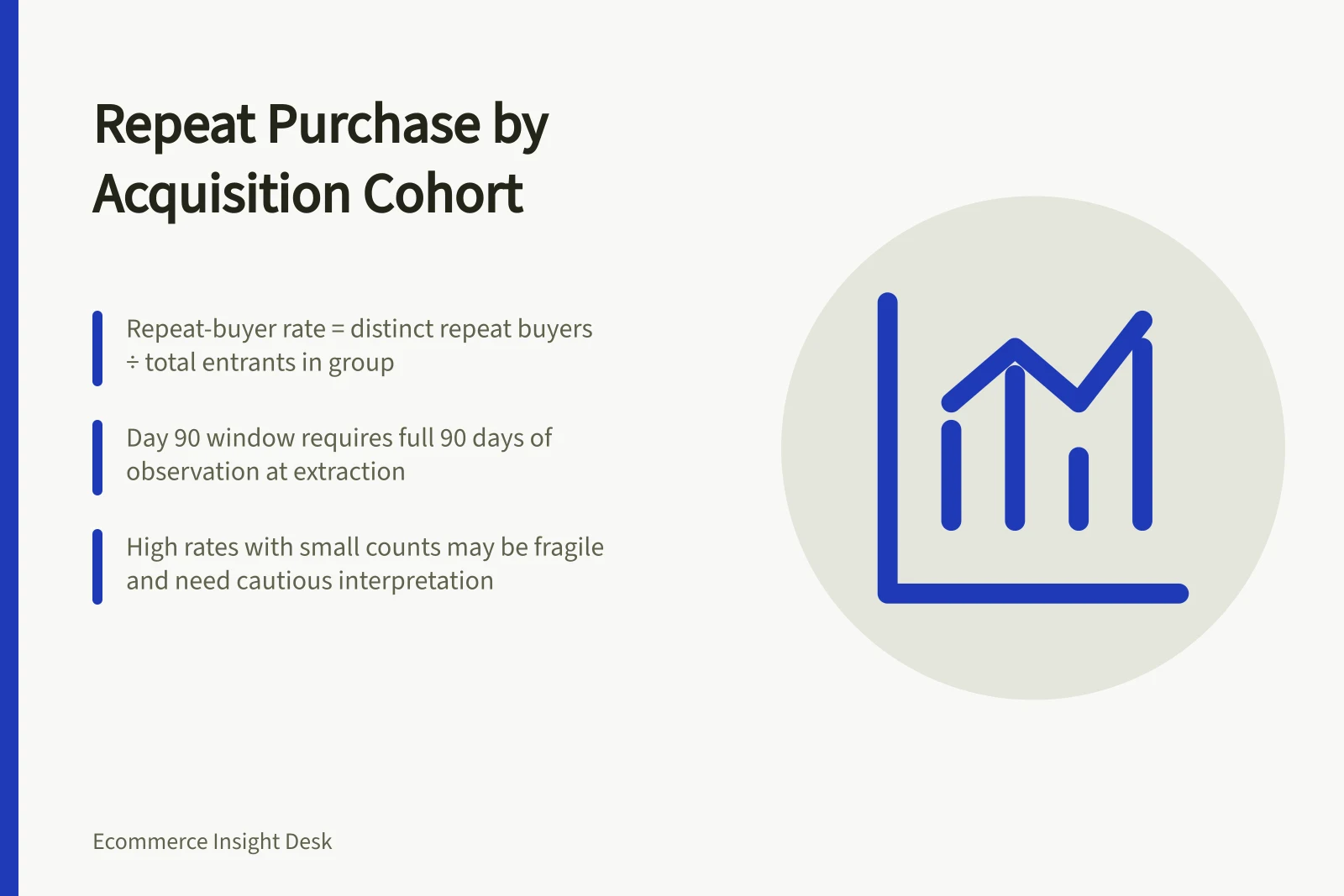
Repeat-buyer rate by day 90 = entrants with at least one later qualifying purchase within 90 elapsed days ÷ all classified entrants in the group.
Day 90 is an example, not a benchmark. Choose the window for the store's buying cycle and state whether the entry day is included. Each entrant must have had the full 90 days of observation at extraction.
If some entrants lack the full window, omit the incomplete group from that completed-window comparison or show it separately as partial. State how cancellations, refunds and unclassified identities affect the counts.
This cumulative measure differs from a period retention rate. Label a custom 'ever repeated by day 90' rate separately.
Read the difference
Show acquisition group, entry period, entrant count, distinct repeat buyers, rate, identity coverage and extraction date. Where possible, compare source groups within the same entry period and at the same age. Look at first-product and offer mix before interpreting a gap: groups may have differed before any repeat purchase was possible.
A high rate based on a handful of customers is fragile, so retain the counts. A higher observed repeat rate identifies a group to investigate; it does not prove that its channel created more loyal customers. Keep attribution and campaign-spend decisions in a separate analysis.