Funnel Analysis
Part of Basket and merchandising analytics
Analysing products commonly bought together
Count product pairs in qualifying orders, compare directional rates and shortlist useful combinations for a measured trial.
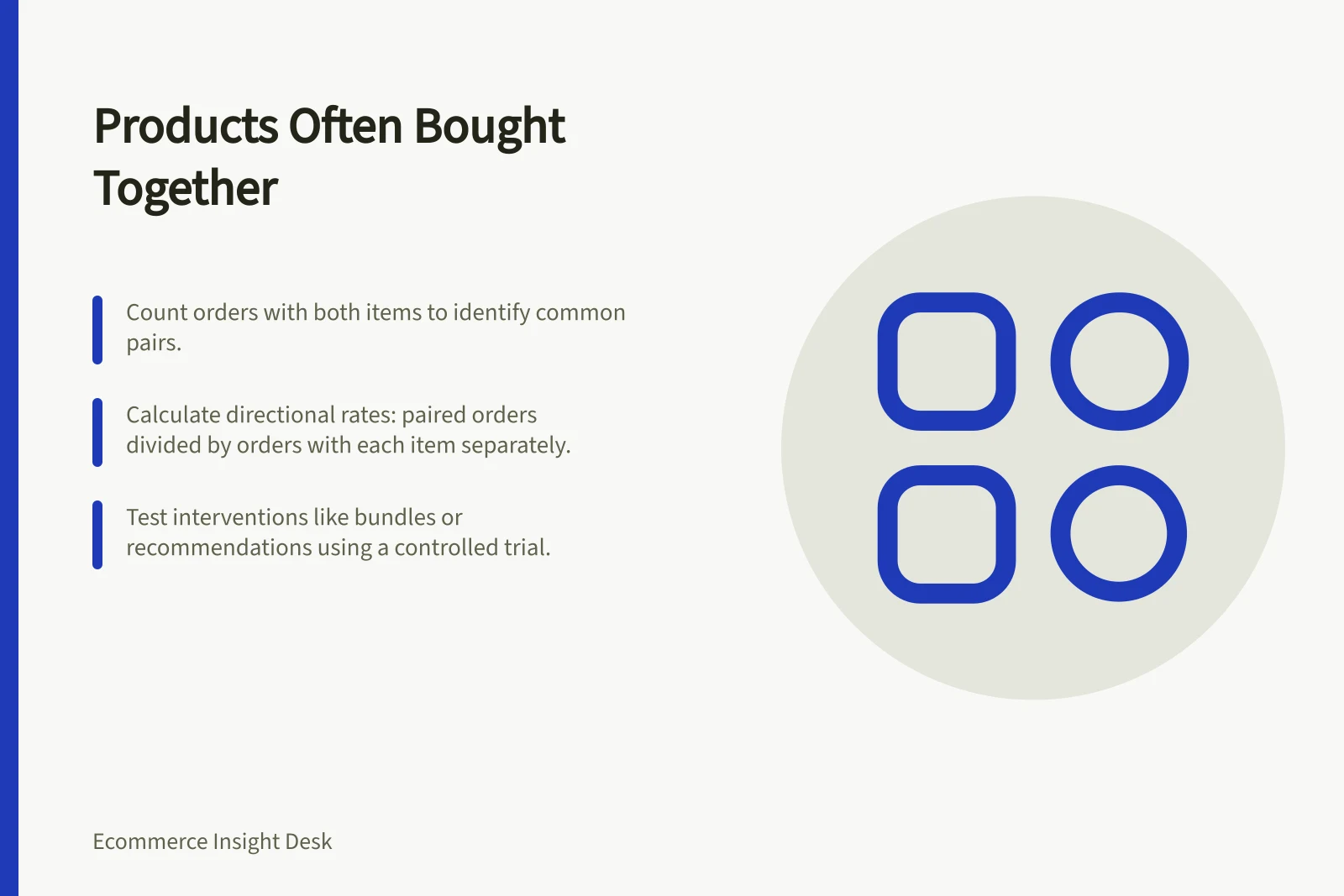
Count qualifying orders containing both items to find products commonly bought together. Compare that count with orders containing each item separately. A frequent pair is a candidate for a bundle or recommendation; it does not show that presenting the items together will create extra orders.
Define the orders and products
Choose the order period, time zone, channels and qualifying statuses. Use parent-product IDs for product-level pairings or variant IDs when size, colour or compatibility matters. Preserve a mapping when identifiers change. State whether later cancellations or order edits alter the population.
For each qualifying order, create a set of distinct item IDs. Count the order once for a pair if both IDs appear, even if the shopper bought several units. An order with three different products contributes three two-item pairs; adding pair counts would count that order more than once.
Order-level pair counts describe items in qualifying orders, not items considered and removed before checkout. Answer that separate question only if separately defined basket records are available.
Put frequency in context
For a proposed pair A and B, show the number of orders containing A, containing B and containing both. Calculate both directional rates: paired orders divided by orders containing A, and paired orders divided by orders containing B. The rates answer different questions, so keep their denominators and raw counts visible.
Inspect the buying context before assigning a role to the pair. The products could be complements, alternatives bought for comparison or parts of a larger project. A promotion or stock gap may also shape the observed pattern. Check whether the proposed companion can be supplied and whether the offer's economics make sense; detailed margin calculation belongs in a separate product or revenue review.
Choose a measured trial
Shortlist pairs that are useful together and specify the starting product, companion, placement and intended outcome. A product-page recommendation and a discounted bundle are different interventions. After launch, compare the defined commercial outcome with a suitable unexposed group where feasible. Continue to report the historical co-purchase rate separately from any measured effect of the new placement.
Steps to Identify and Test High-Value Product Pairs
- Shortlist useful product pairs based on co-purchase frequencyUse historical order data from Shopify or Bloomreach Discovery
- Define intervention type (e.g., bundle discount, product recommendation)Choose placement on product page or checkout
- Set up controlled trial with unexposed groupCompare conversion rates before and after intervention
- Measure commercial outcome (e.g., uplift in ATO-compliant revenue)Track GST-inclusive sales and margin impact