Funnel Analysis
Part of Ecommerce conversion funnels
Measuring drop-off between shopping stages
Calculate shopping-stage drop-off with consistent counts and clear denominators, then check skipped routes and missing events.
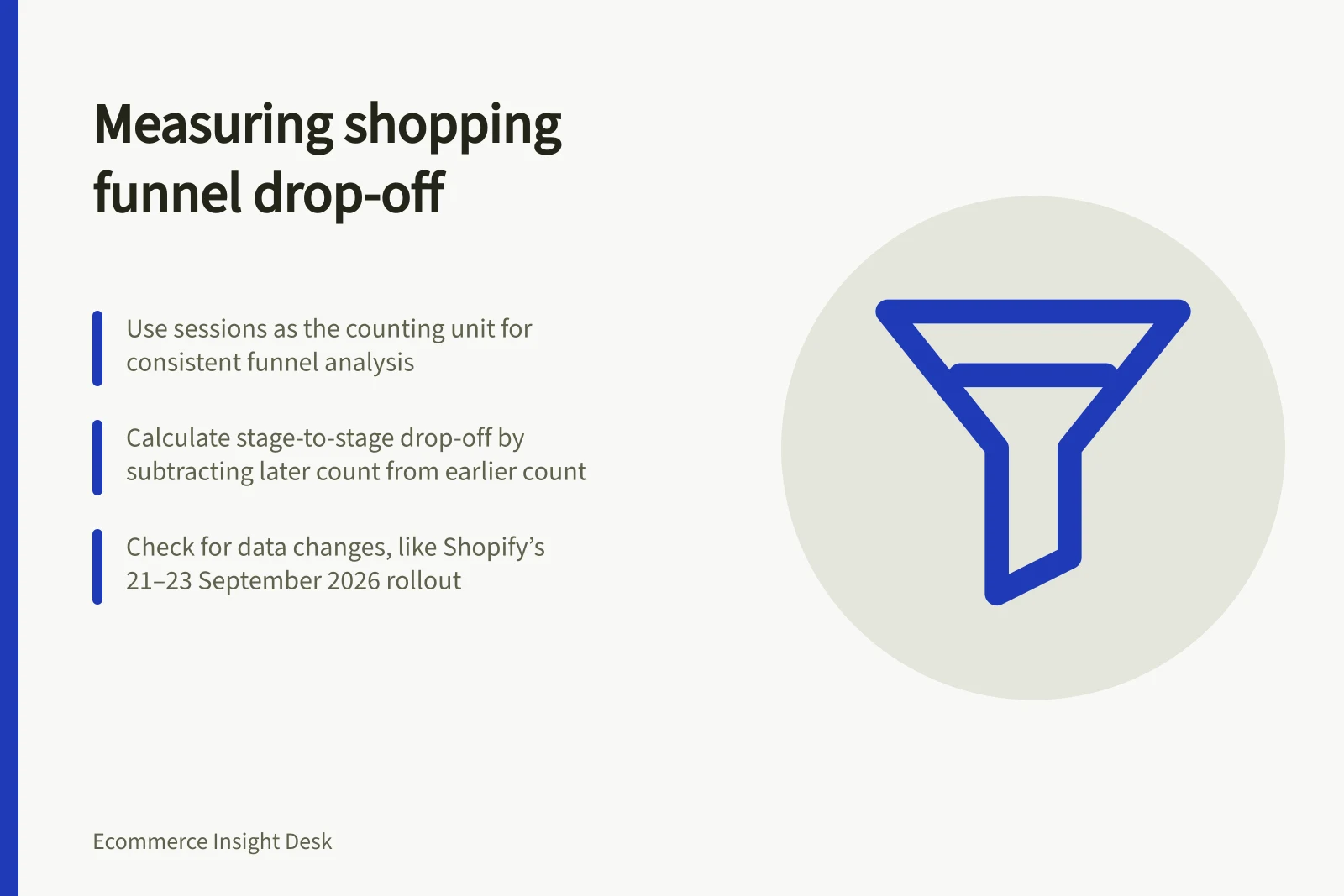
To measure drop-off between two consecutive shopping stages, subtract the number reaching the later stage from the number at the earlier stage. Divide the difference by the earlier count for the stage-to-stage rate. Use one counting unit and one set of funnel rules throughout.
Fix the population
Choose a starting stage that fits the question: product viewers for product-to-basket movement, or checkout entrants for completion after checkout starts. Record the date range, time zone, exclusions, entry rule and any time limit.
Choose users or sessions and keep that unit across stages. Shopify’s Conversion rate breakdown counts sessions. Check the unit used by any other report before comparing; do not subtract a user count from a session count.
Shopify’s open Conversion rate breakdown can include sessions whose steps occur in any sequence. Interpret its stage counts accordingly.
Calculate adjacent gaps
Suppose a hypothetical closed session funnel records 1,000 sessions with a basket addition, 600 that reach checkout and 420 that complete checkout.
| Transition | Earlier count | Later count | Observed drop-off |
|---|---|---|---|
| Basket addition to checkout | 1,000 | 600 | 400 sessions; 40% of the earlier count |
| Checkout to completion | 600 | 420 | 180 sessions; 30% of the earlier count |
The completion rate from basket addition is 420 ÷ 1,000, or 42%. It answers a different question from either adjacent-stage rate. Show counts alongside percentages so small populations remain visible.
These are observed session paths, not lost-order counts. A shopper may purchase in a later session, and an express route may skip a required basket stage. Check an appropriate route-specific or open view before treating a missing stage as abandonment.
Check the result before acting
Compare the same transition across suitable periods without changing its definition. Note changes in promotions, stock, traffic mix and the site. If a Shopify session comparison crosses its 21–23 September 2026 measurement rollout, treat the break in session measurement as a possible explanation for movement.
Confirm that each reported stage represents the intended action on the routes being counted. Missing or inconsistent stage data can affect later counts, so interpret observed rates in light of the report definitions.
Prioritise a gap using its underlying count, persistence and business relevance. Investigate checkout and order evidence for a gap after checkout entry, or the shopping path for an earlier gap. The measured rate locates a question; it does not establish the cause.