Measurement Planning
Part of Promotion analysis
Separating seasonal demand from promotional uplift
Build a seasonal baseline for an ecommerce sale, show uncertainty in estimated uplift and plan a stronger comparison for the next offer.
During a busy period, a sale can coincide with rising orders even if the offer adds little demand. Estimate what would have happened over the same dates without the promotion, then compare that baseline with the observed result. The difference is an estimate whose strength depends on the comparison.
Start with the trading calendar
Record the offer dates and times, eligible products, markets and channels. Mark relevant public holidays, other campaigns, price changes, stock gaps and site incidents. Choose one outcome, such as qualifying units or retained product sales, and apply the same order-status, time-zone and return rules throughout.
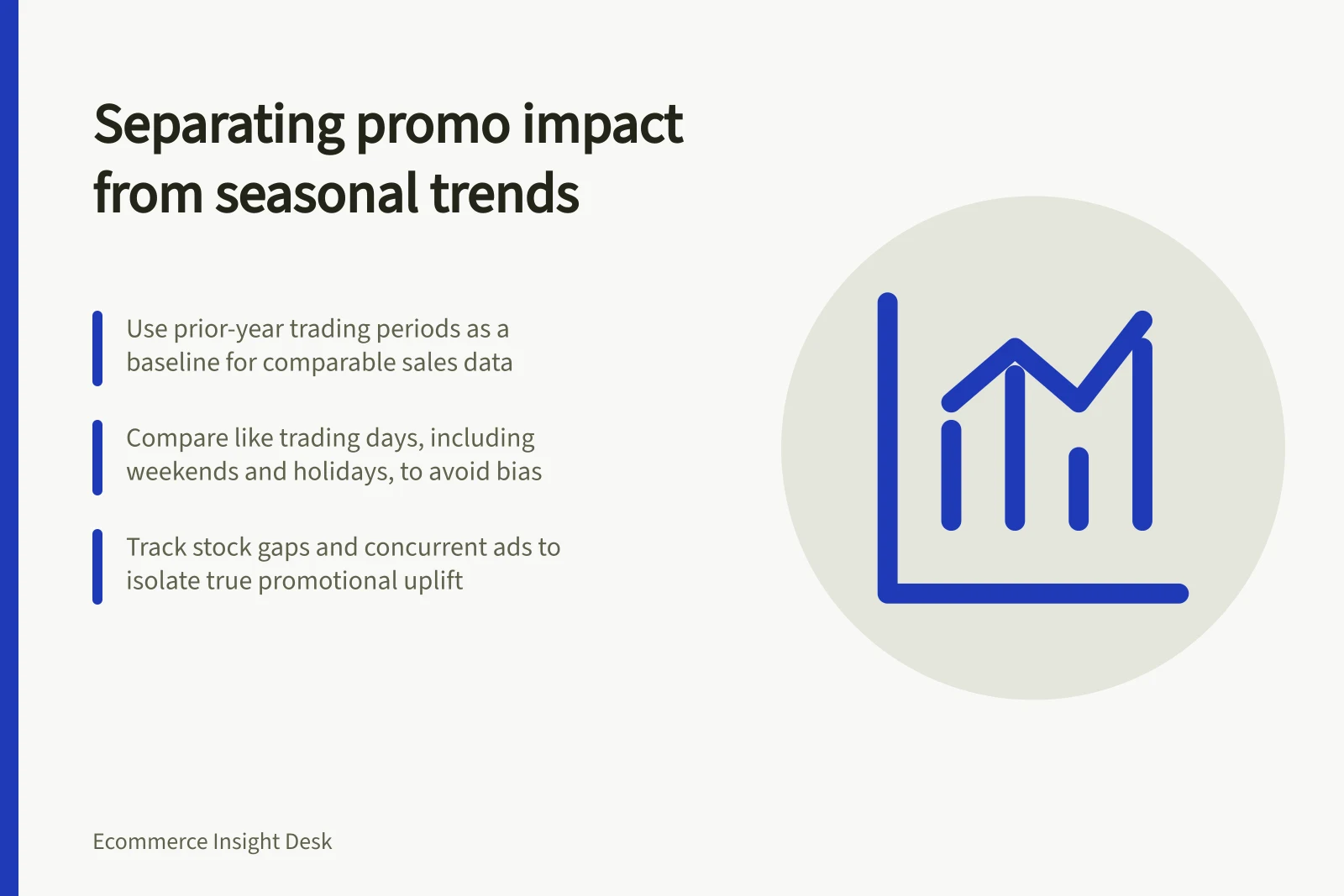
Compare like trading days. A weekend sale should not be judged against an ordinary weekday. Earlier periods help when product availability, prices, audience and advertising were similar.
The equivalent season in a prior year can reveal recurring patterns, but the assortment and demand may have changed. Neither period automatically represents sales without the current offer.
Google's Meridian data guidance says non-media treatments can include promotions and product prices. Its GeoX guidance recommends longer pretest history when a business has strong seasonal or cyclical patterns.
Show more than one defensible baseline
An unaffected product group may help track common demand, provided the offer could not draw sales towards or away from it. A similar market may help if earlier trends are comparable and customers are unlikely to cross between markets. Day-of-week and holiday matching can improve a historical comparison, but unrecorded competitor activity or a simultaneous site change can still distort it.
For each reasonable baseline, show the expected and observed outcome over the same event window. Call their difference estimated excess sales until there is evidence that the offer caused it. Report a range across defensible baselines rather than selecting the most favourable estimate. Inspect the period after the sale too: a surge followed by a dip may reflect purchases brought forward.
Mark stock gaps explicitly. A poorly stocked comparison period can make current sales appear unusually high; a stockout during the promotion can hide demand. A concurrent increase in advertising also prevents a simple before-and-after comparison from separating the offer from its media support.
Plan a stronger comparison
Where practical, assign comparable eligible customers or markets to receive the offer or continue under normal conditions. Define the assignment unit, offer difference, primary outcome and follow-up period before launch. Compare all assigned units, including those with no orders, and check for exposure crossing between groups.
Running both groups over the same dates helps account for broad seasonal conditions, though local differences and implementation problems still matter.
Report recorded event sales, the seasonal baseline estimate and the resulting excess separately. State which other changes could explain the difference. If that uncertainty could reverse the repeat-or-stop decision, design the next offer to answer it more directly.
Planning a Stronger Comparison for Future Promotions
- Define Assignment UnitEligible customers or markets
- Assign Groups (Offer vs Control)Randomised or matched pairs
- Run Both Groups Over Same DatesAlign with seasonal conditions
- Monitor Exposure CrossingEnsure no overlap between groups
- Report Separately: Sales, Baseline, ExcessInclude uncertainty and confounding factors